
藝評
Sara Tse: Seed to Textile 2025 – Woven Campus 種學織文2025 – 交織的校園
約翰百德 (John BATTEN)
at 11:56am on 11th May 2026
(This review was originally published in English and Chinese in Artomity art magazine, March 2026)
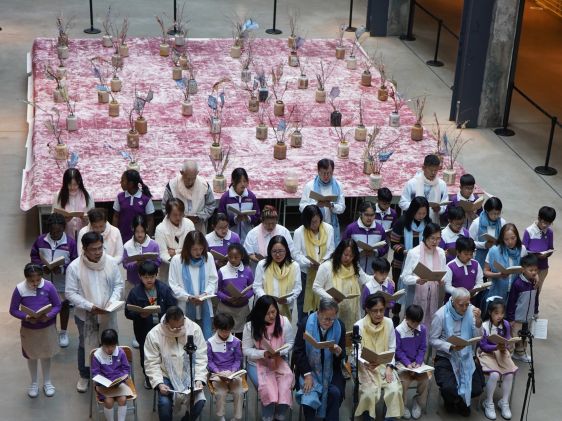
Above image: Sara Tse (in pink, front row), with alumni and students singing in front of her Woven Campus installation at CHAT, Tsuen Wan.
種學織文2025 – 交織的校園
約翰・百德
過去五年間,香港藝術家謝淑婷致力記錄她與姐姐的幼時母校葵涌公立學校。學校創立於1952年,原為鄰近鄉村孩童而設,部分村落至今仍有人居住。學校坐落於葵興青山公路旁一座小山丘上,需沿狹窄小徑而上,四周樹木環繞。那個年代的村校多由政府工務建築師統一設計:大型校舍、粉飾磚牆、單層建築、斜頂課室,圍合成U形開放空間,既是操場,也是露天集會廣場。謝淑婷的母校操場一端亦設有半露天的混凝土講台,讓老師在早會時使用。
這些學校曾被當地社群引以為榮,經費與物資仰賴家長與本地捐助者支持。與許多學校一樣,葵涌公立學校在重要的講台位置,鑲嵌鳴謝牌匾與瓷磚肖像鳴謝捐助者。儘管香港直至1971年才推行強制免費小學教育,這間小學卻早已學生滿額。1949年中國內戰結束後,大批難民湧入,加上區內木屋區急速增加,令學位需求大增。
戰後經濟起飛為葵涌帶來翻天覆地的變化,區內開始都市化發展,工作機會亦大幅增加。港口設施(今日的貨櫃碼頭)向外擴展,沿海村落被遷往內陸。大型公共屋邨逐步取代山坡上的簡陋木屋,工廠大廈逐漸在校舍周邊拔地而起。在這些地區發展以外,隨著更大型的新校落成,加上交通愈見完善,學生開始可以前往其他地區,特別是鄰近的荃灣就學。細小的葵涌公立學校最終停辦,空置多年。如今校舍已被清拆,樹木移除,山丘夷平,原址即將重新發展。
謝淑婷在得知母校面臨清拆之際申請進入校園,最初只是記錄校園本體、其建築設計、周邊樹木與自己童年喜愛的角落。她為仍然完好的牌匾、牆面與地面製作拓印,拍攝並錄下校園的聲音。原本這只是一項個人藝術/研究計劃,後來發展成她邀請朋友與校友重訪,安排校園導覽,並邀請其他學校的藝術家與學生參與。學校的歷史與故事被憶記和記錄,也被非舊生重新想像。多代舊生,不少如今已長大成人,有份參與這項計劃。
謝淑婷對母校所進行的研究與記錄,以及其藝術演繹,至今仍未完整呈現,未來有望會發展為更大型的展覽。荃灣六廠紡織文化藝術館(CHAT六廠)透過社群計劃「種學織文」支持謝淑婷的項目,計劃旨在以親身參與的方式,探索自然、紡織與藝術之間的聯繫。雙方的合作非常成功,除了保留了謝淑婷的校史研究與校友的合作精神,也回應了CHAT六廠的宗旨,為項目注入了紡織元素。
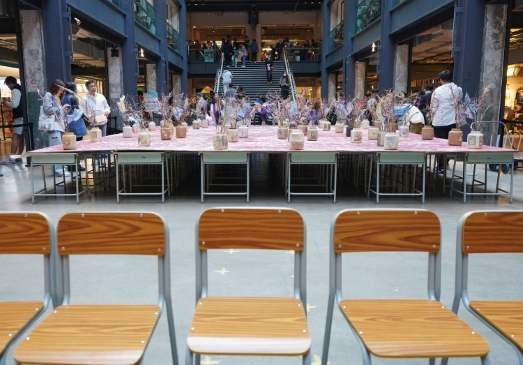
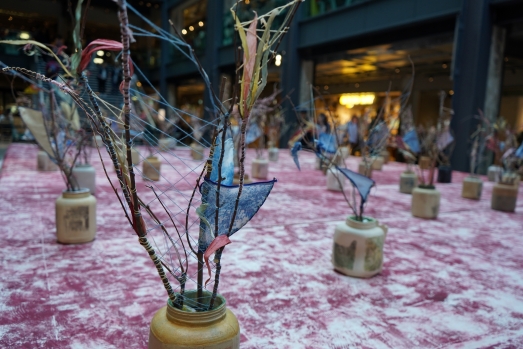
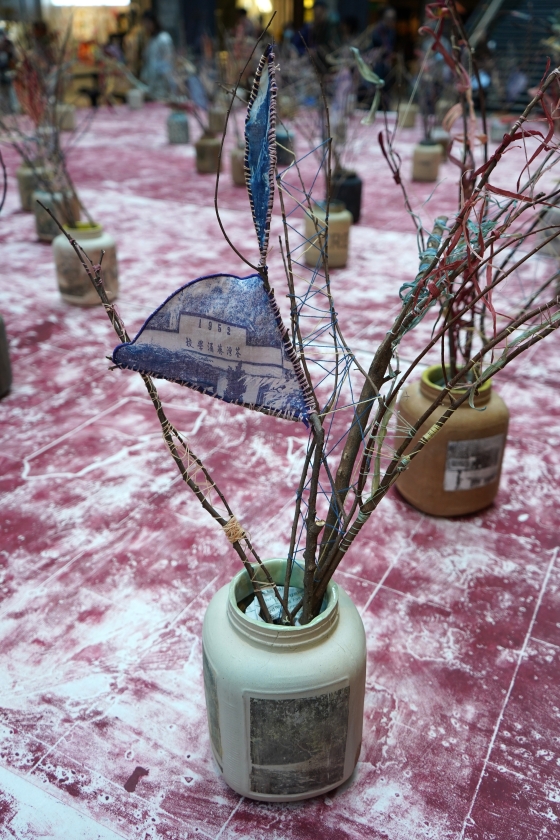
Detail of Sara Tse's installation (photo: John Batten)
2025年,謝淑婷帶領一群「種子隊」,包括校友、公眾義工,以及元朗八鄉中心小學的學生,在CHAT六廠毗鄰、前身為紡織廠的南豐紗廠天台耕地栽種香港常見植物。他們在謝淑婷的帶領下,以植物製作天然染料和收集纖維。他們於工作坊中,創作與葵涌公立學校相關的物件:染布、製作表面轉印圖像與文字的玻璃糖果罐造型陶瓷瓶,以及藍曬照片。染布與照片被細緻地編織於細樹枝之間,然後置入陶瓷瓶中展示。
部分合作成果先於2025年8月在CHAT六廠畫廊空間小規模地以開放工作室形式展出。數月後,「種學織文2025 – 交織的校園」在CHAT六廠主展廳展出,雖然為期只有三日,但這個版本更完整有力。
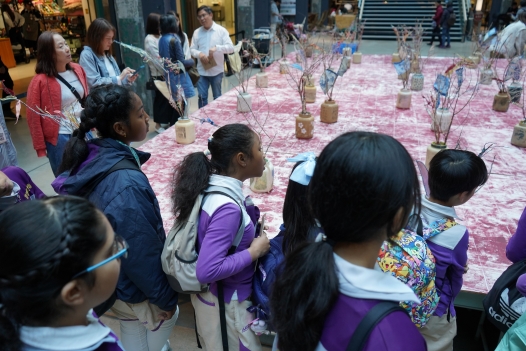
Children from Pak Heung Central Primary School participated-in and visited Sara Tse's project at CHAT, Tsuen Wan (photo: John Batten)
裝置設置於借來的校桌之上,桌面上有一張長紙,上面以紅色拓印謝淑婷母校富有記憶感的瓷磚地板。陶瓷一直是謝淑婷創作的重要媒介,她精緻的瓷漿裝置作品曾於國際展覽中展出。這次展覽中,鑄製的陶瓷瓶分佈於紙上,每個陶瓷瓶伸出一枝小樹枝,交織著手染織物與藍曬照片。每個陶瓷瓶都像一個微型場景,捕捉校園的不同面貌以及近代的往昔片段。整個裝置帶有強烈的手作和貼地感,令人想起學校的集體藝術作業。裝置不是依賴對已拆校舍的懷舊,而是成功呈現一種孩童般的活力與迎接未來的熱情。
展覽開幕當日在CHAT六廠主展廳的一個亮點,是義工與學生佩戴手染圍巾,以特別印製的歌集唱校歌,包括葵涌公立學校的校歌(同為培英中學校歌)。歌聲背後,巨型的《交織的校園》靜靜佇立,強而有力地捕捉一所深受愛戴但如今已逝校園的生命與精神。
Review
by John Batten
Sara Tse: Seed to Textile 2025 – Woven Campus
Over the last five years, Hong Kong artist Sara Tse has assiduously documented the school that she and her sisters attended when young. Opened in 1952, Kwai Chung Public School was a primary school for children living in nearby rural villages, some still inhabited today. It was reached by a narrow pathway, sited atop a small hill, surrounded by trees on Castle Peak Road in Kwai Hing. Hong Kong’s rural schools from this period were all similarly designed by government public works architects: large rendered brick single-storey pitched roofed classrooms arranged around a U-shaped open space doubling as both playground and outdoor assembly area. Tse’s school also had a covered open-air concrete podium at one end of the playground, used by teachers at school assemblies.
These schools were the pride of a local community and were supported financially and materially by parents and local donors. Like many schools, Kwai Chung Public School honoured its beneficiaries with acknowledgement plaques and applied photo-portraits on ceramic tiles – these were prominently placed on the school’s podium. Although free compulsory primary school education in Hong Kong was not introduced until 1971, this small school was fully attended due to the dramatic influx of refugees from the mainland after China’s civil war ended in 1949 and the increase of squatter housing throughout the district.
The post-war economic boom brought dramatic changes to Kwai Chung. The area saw urban development and increased work opportunities. Coastal village communities were removed inland as Hong Kong port facilities (now container terminals) expanded. Mass residential public housing was built, slowly replacing Kwai Chung’s precarious hillside squatter huts. Over time, the school was surrounded by industrial buildings. Alongside these developments, newer and larger schools opened and better public transport allowed children to commute to schools in other areas, particularly to nearby Tsuen Wan. The small Kwai Chung Public School eventually closed and was unoccupied for many years. It has now been demolished, the surrounding vegetation cleared and hill flattened; the site will soon be redeveloped.
Tse knew of the school’s imminent demolition and she requested permission to visit. Initially, she documented the physical school, its architecture, surrounding trees and her favourite places while a student. She made rubbings of the intact plaques, walls and floors. She photographed and recorded the surrounding sounds of the school. Initially this was a personal art/research project, she then invited friends and the school’s alumni to visit. She arranged tours of the school. She involved artists and students of other schools. The heritage and the school’s stories were recalled, recorded and – for those that were not alumni - reimagined. Generations of students, many now adults, contributed to Tse’s art project.
Tse’s investigations and documentation about her school and her artistic interpretations have not as yet been fully realised – hopefully this will be a future, larger exhibition. However, the Centre for Heritage, Arts and Textile (CHAT) in nearby Tsuen Wan tapped Tse’s project to be supported under their yearly Seed to Textile project. This was a good collaboration. The essence of Tse’s own research and alumni collaborations were preserved, and CHAT’s aims were met by introducing a textile element to her project, as explained: “(Since 2019, Seed to Textile is)…CHAT’s flagship community programme…acquainting artists and the public with the connections between nature, textiles and art, offering hands-on experiences ranging from farming to gallery practice.”
Throughout 2025, Tse led a group of ‘Seeders’ – her school’s alumni, public volunteers and students from Pak Heung Central Primary School – to cultivate common Hong Kong plant species on the rooftop garden of The Mills (CHAT’s adjacent former textile-manufacturing factory building). Led by Tse, the Seeders produced natural dyes and fibres harvested from their plants. In collaborative workshops, objects related to Kwai Chung Public School were made: textiles were dyed; ceramics pots in the shape of candy-shop glass jars were cast and transferred images and text attached to their exterior; and, cyanotype photographs were printed. Then, the dyed textiles and cyanotype photographs were skilfully woven in, around and between small tree branches and twigs. These were then placed inside the ceramic pots, ready to be displayed.
Sections of this collaboration was first seen in a small exhibit in August 2025 as an ‘Open Studio’ setting in CHAT’s gallery spaces. Four months later, a more complete and impressive showing of the collaborations was shown in a too-brief - but powerful - three-day presentation in CHAT’s main hall, titled Seed to Textile 2025 – Woven Campus.
The Woven Campus installation was set-up atop borrowed school desks. Literally underpinning the display were long sheets of paper on which the evocative floor of Tse’s school had been rubbed red, replicating the school’s tiled floors. Ceramics have always been an integral component of Tse’s artwork; her elaborate slipped porcelain installations have been internationally exhibited. In this display, the cast ceramic pots are spread across the paper floor. Inside each pot, a small tree branch emerges with an intricate weaving of hand-dyed textiles with an embedded cyanotype photograph. Each pot is like a small diorama, capturing an aspect of the school and its recent educational and playground past. The overt hand-made, down-to-earth appearance of the entire installation is reminiscent of a group school art project. Successfully, the installation doesn’t rely on the nostalgia of a demolished school, but presents child-like energy and forward-looking enthusiasm.
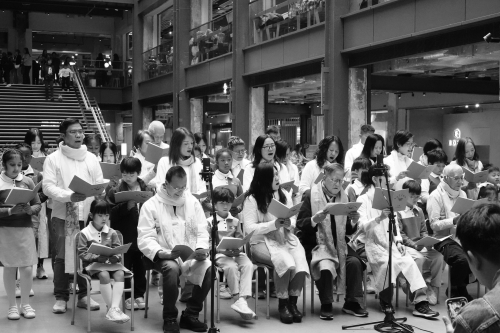
Hong Kong artist Sara Tse (front row, fourth from left), with alumni and students singing during the opening of her Woven Campus installation inside the large main hall at CHAT, Tsuen Wan, Hong Kong (photo: John Batten)
One highlight of the opening reception in CHAT’s main hall were volunteers and school children wearing dyed scarves while singing school songs - from a specially printed ‘school song book’ – including Kwai Chung Public School’s original school song also adopted by Pui Ying Middle School. Quietly sitting behind the singers was the large Woven Campus – powerfully capturing the life and vigour of a loved school, now gone.
Sara Tse: Seed to Textile 2025 – Woven Campus
Centre for Heritage, Arts and Textile (CHAT), Tsuen Wan, Hong Kong
10-13 January 2026