
藝評
Book Review: ''Media, internet, and social movements in Hong Kong: control and protest''
約翰百德 (John BATTEN)
at 8:08pm on 26th April 2026
Book Review
by John Batten
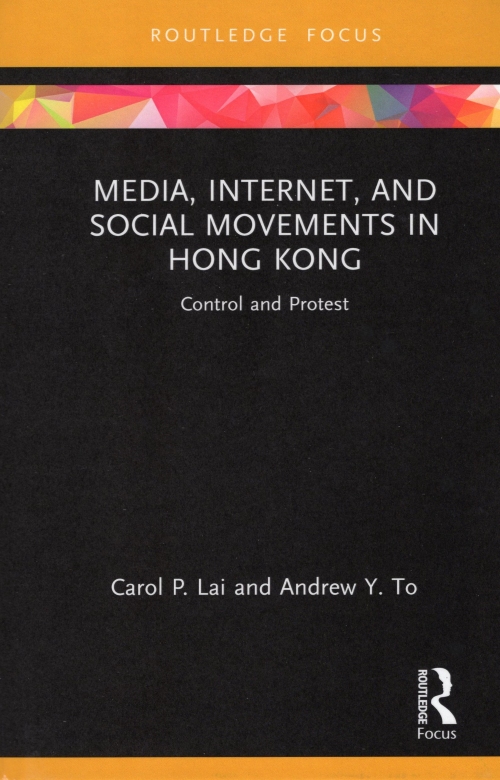
Carol P. Lai & Andrew Y. To, Media, internet, and social movements in Hong Kong: control and protest, Routledge, 2025, 119 pages.
Media, internet, and social movements in Hong Kong is a new addition from academic publisher Routledge in their Focus on Communication and Society series, written by Carol Lai, FCC correspondent member and retired Associate Professor in Global Communications at Akita International University in Japan, and Andrew To, retired Assistant Professor in the Department of Journalism at Hong Kong Baptist University. Their essays focus on the rise of Hong Kong’s social and political movements in the 1980s and – for the central government – the unnerving 2014 and 2019 street protests, spread of localism and increasing anti-government sentiment.
The consequences of the protests, the introduction of the National Security Law in 2020 and a changed media and social landscape is discussed by looking at the rise and demise of pro-democracy groups and pressure on Hong Kong’s liberal media, the internet and social media. Also considered are institutions that previously had great freedom of organisation, such as trade unions and independent NGOs, including the Hong Kong Journalists’ Association. The role of Apple Daily in promoting democracy in Hong Kong, its forced closure, and the arrest and trial of its owner Jimmy Lai and editors is a focus of the book.
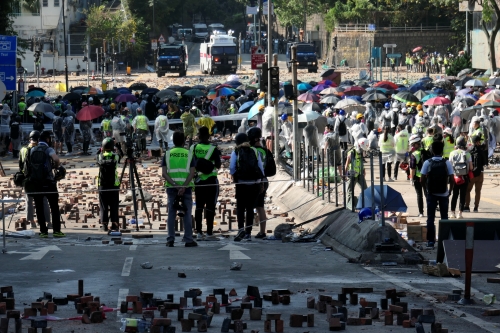
Journalists behind the protest frontline during protests outside The Hong Kong Polytechnic University, 2019 (photo: John Batten)
The authors analyse Hong Kong’s decline from having one of Asia’s most open media environments, to – emphasised by the closures of the online House News, Stand News, Citizen News and Apple Daily – a landscape where media ‘red lines’ are ill-defined, journalists’ self-censorship has become increasingly common, and media proprietors hesitate employing strongly opinionated columnists and cartoonists. The FCC’s annual survey of journalists corroborates this opinion.
There is a good summary of Hong Kong’s post-1989 political development and the rise of the pro-democracy camp and the support it garnered from the public in the Legislative Council geographical constituencies. There is less analysis about the city’s current political landscape and the strong role that the central government through the Liaison Office now plays, and its relationship with Hong Kong’s media.
The local media’s political commentary on government decision-making has noticeably dropped since 2020, but in one area of reporting it has hardly changed and this disparity is surprisingly not explored in the book. The city’s financial press continues to strongly analyse Hong Kong and mainland economic and finance - and by extension, political – news and policies. The international financial community expects and requires Hong Kong, as a major finance and banking centre, to have open business reporting. Crossover political-financial topics, such as the mainland’s current property woes or central government policies to control the renminbi, continue to be liberally analysed. Likewise, the city continues to have open internet access and, despite at times incurring the displeasure of mainland authorities, such newspapers as the Financial Times and Wall Street Journal continue to be widely read, whilst Bloomberg and Reuters have a strong bureau of journalists in the city.
Alternatively, Lai and To identify that local official tolerance for political satire has plummeted after the cancellation of satirical television programmes and Hong Kong’s leading cartoonist Zunzi Wong lost his long-running daily newspaper cartoon in Ming Pao in 2023. His contributions to Apple Daily had discontinued with its closure in 2020.
Lai identifies that after the 2014 umbrella protests, “...the promise of democracy was not delivered but also not gone,” and that Carrie Lam’s 2019 Extradition Law Amendment Bill “revived and reinvigorated” the pro-democracy camp. Also apparent, but possibly not by pro-democrat legislators at the time, was that the central government’s tolerance of public mass protests and Legislative Council disruptions by some legislators had begun to harden. The principle of holistic national security for China was first announced by President Xi Jinping in 2014 and in the following years has increasingly became a core policy of the central government, which identified 20 areas of national security, including cultural security and political security.
Following Hong Kong’s 2019 protests, the efficient introduction of the National Security Law in 2020 and the city’s electoral changes of “patriots ruling Hong Kong” was of little surprise. Over the last decade and citing national security, mainland authorities had been tightening their oversight of organisations that collected or disseminated information. The reigning-in of Alibaba’s expansion plans was the most high profile. Following a similar tightening on the mainland, Hong Kong’s media was inevitably caught in the mainland’s national security cross-hairs.
In this light, Lai’s discussion of the city’s once vigorous culture of news-gathering and investigative journalism, including Apple Daily-style tabloid sensationalism, reads as a sad ode to the city’s recent, post-1989 media landscape. Jimmy Lai and his evolution as proprietor, spearheading the editorial line of Next Digital and Apple Daily and its positioning as a pro-democracy publication, but viewed by the central government as being “anti-China” almost mirrors one reading of Hong Kong’s own societal and political events over those years. However, Lai does identify that InmediaHK and Hong Kong Free Press, both subscriber-supported and online, have navigated the current media landscape well and that Hong Kong Free Press “upholds a relatively independent editorial policy, focused on selected local news mainly related to politics, court news, and minority news” and has assiduously covered the Jimmy Lai trial and other possibly sensitive news topics.
At the end of his contributing essay, To bluntly summarises his opinion of the consequences of the mainland response to the 2019 protests, these include: "…The political space for China and pro-democracy Hongkongers to co-exist and compete evaporated....Representative politics has been abolished and the competitive race for directly elected seats ended. Hongkongers’ rights and powers of opposition and resistance have been uprooted....The whole operation (for Beijing) is a success.... And the rest is history.”
And the future, of course, will be other stories yet to be written.
|
|
|
|
|
|